AIChatOne Review - All-in-One AI Assistant Chrome Extension
Why the Single-Model AI Strategy Is Costing You
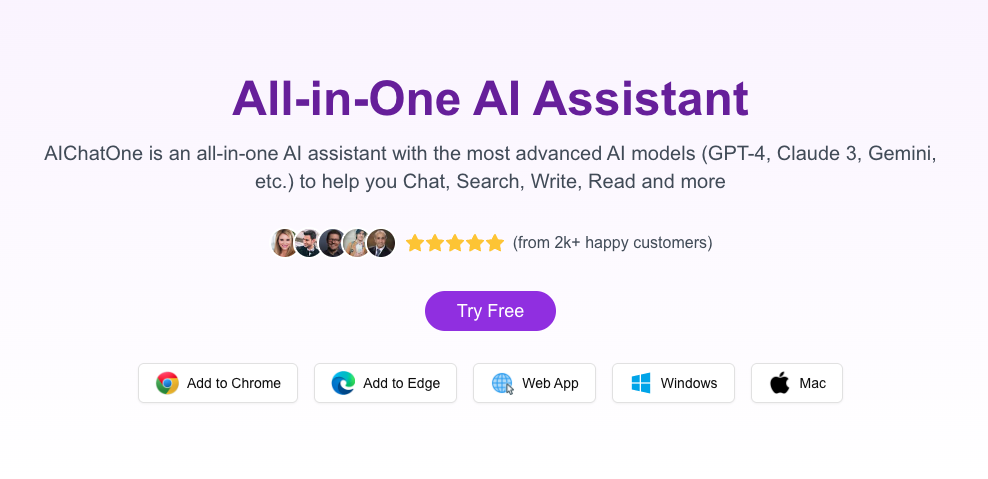
The assumption that any single AI model delivers optimal performance across every type of task has become increasingly untenable. ChatGPT handles certain categories of queries beautifully but stumbles on others. Claude excels in different domains entirely. Gemini brings distinct architectural strengths to bear. When you commit to a single model, you're accepting suboptimal results on roughly 60% of your daily queries — not because the tools are inadequate, but because no single implementation is designed to be universally dominant.
AIChatOne operates on a straightforward but powerful premise: maintain your own API relationships with multiple model providers and let the extension help you route each query to the tool best suited for it.
Model Specialization Isn't Marketing
The differentiation between frontier AI models reflects genuine architectural divergence:
ChatGPT: Instruction-following and structured reasoning are its core competencies. Particularly strong on multi-step problem decomposition, standard-pattern code generation, and tasks requiring careful procedural adherence.
Claude: Excels at nuanced edge-case reasoning and handling ambiguous or contradictory constraints. Writing quality, editorial judgment, and scenarios where the right answer depends on understanding unstated assumptions are where it pulls ahead.
Gemini: Deeper grounding in structured knowledge domains and multimodal understanding. Vision-based analysis, real-time information synthesis, and cross-document reasoning favor Gemini's architecture.
DeepSeek: A cost-effective reasoning engine optimized for high-volume, routine analytical workloads. Bulk data processing, standardized report generation, and budget-constrained automation pipelines benefit from DeepSeek's efficiency profile.
Relying on any single model means handicapping yourself on 40%+ of queries where a different model would deliver materially better output.
AIChatOne's Architecture: A Routing Layer, Not a Wrapper Service
The platform functions as a transparent coordination layer rather than yet another AI-as-a-service middleman:
Your infrastructure, your control: You supply API keys directly to each model provider. AIChatOne never intermediates your credentials. They don't store API keys on their infrastructure.
Direct provider connections: Queries pass from the AIChatOne interface directly to the chosen model provider's API endpoints. AIChatOne coordinates — it doesn't process or inspect your request payloads.
Complete vendor independence: If AIChatOne ceased operations tomorrow, you'd lose the interface convenience but retain full access to every conversation through your existing API provider accounts. There's no business-continuity dependency.
This architectural distinction is material. You're not betting on AIChatOne's longevity, their data handling policies, or their infrastructure uptime. You're betting on the model providers themselves — and those relationships are yours, not AIChatOne's.
Side-by-Side Query Performance Comparison
Running identical prompts through every available model revealed consistent specialization patterns:
Code Architecture Review Prompt: ChatGPT delivered solid technical observations but missed a critical concurrency-model edge case. Claude provided comprehensive analysis including the edge case. Gemini offered competent feedback with slightly less analytical depth. Winner: Claude.
Marketing Copy Refinement Prompt: ChatGPT produced competent but generic improvements. Claude delivered elegant rewrites that preserved the original brand voice while elevating the prose. Gemini maintained technical precision but flattened the brand character. Winner: Claude.
Mathematical Proof Verification Prompt: ChatGPT was correct but verbose in explanation. Claude was correct with tighter exposition. Gemini was correct and presented the most systematically structured breakdown. Winner: Gemini.
Rapid Data Extraction from Unstructured Input: ChatGPT extracted accurately and quickly. Claude was methodical but slower. Gemini combined speed and accuracy most effectively. Winner: Gemini.
The pattern is clear: no single model dominates across task categories. Different challenges have different winners. Committing to one model is a strategic self-limitation.
Feature Set
One-Time Configuration: Add API keys for whichever providers you use. Takes approximately 15 minutes. You never revisit the settings unless you rotate credentials.
Compose Once, Query Multiple Models: Draft your prompt once. Select which models to engage. Compare answers side-by-side in a single view.
Conversation Organization: Group threads by model or by topic. Cross-search all conversation histories simultaneously regardless of which model generated which response.
Web Context Capture: Highlight text anywhere on the web. Route it to any model for analysis without copy-pasting between browser tabs.
Persistent Sidebar: Keep AIChatOne visible alongside your primary workspace. Instant access without the alt-tab friction that fragments attention.
Global Keyboard Shortcut: Customizable activation keybinding summons AIChatOne from any context. For heavy daily users, the seconds saved per interaction compound into hours of recovered attention weekly.
The Cost Math: API Access vs. Flat-Rate Subscriptions
Standard Subscription Approach (ChatGPT Plus):
- $20 monthly for one model
- Can't access Claude or Gemini capabilities
- Annual spend: $240+ for single-model access
Multi-Model API Approach:
- ChatGPT API: approximately $0.50 per million input tokens
- Claude API: roughly $3–15 per million tokens depending on model tier
- Gemini API: free tier available with usage-based pricing beyond
For moderate usage patterns — 10 to 20 queries daily — expect combined monthly costs across all providers in the $3–10 range. Annual comparison: $240 for a single-model subscription versus $50–120 for multi-model API access. That's 50–80% in savings while gaining access to model diversity that the subscription model can't provide.
Workflow Patterns That Compound
Research workflow: Highlight a section of a research paper. Send the excerpt to Claude for deep analytical reasoning. Simultaneously send it to ChatGPT for an alternative perspective. Compare both analyses and synthesize insights that neither model would have surfaced alone.
Code review workflow: Paste a block of code into AIChatOne. Route it to ChatGPT for performance optimization suggestions. Route the same code to Claude for security vulnerability analysis. Route it to Gemini for maintainability and architectural coherence assessment. Compile a unified review from three distinct analytical perspectives.
Writing workflow: Draft content. Ask Claude for a stylistic enhancement pass. Ask ChatGPT for a clarity-focused revision. Select whichever version best serves your purpose or synthesize the strengths of each.
Each of these workflows previously demanded navigating between multiple browser tabs or entirely separate interfaces. AIChatOne consolidates them into a single interaction surface.
Competitive Context
vs. OpenRouter: Also offers multi-model access but imposes a markup on API consumption. AIChatOne routes through your own native API accounts, avoiding intermediary pricing layers.
vs. Native Model Interfaces: ChatGPT, Claude, and Gemini each provide web-accessible interfaces, but they're siloed. AIChatOne provides the consolidation layer that none of them offer individually.
vs. IDE-Integrated AI: Cursor and similar development environments offer some multi-model capabilities but remain code-centric. AIChatOne serves as a general-purpose tool.
AIChatOne's structural advantage: it's the lowest-cost option for technically proficient users who are comfortable managing API credentials, and it provides true multi-provider independence without tying you to any intermediary's business trajectory.
Implementation Reality
Setup sequence:
- Install the Chrome extension (1 minute)
- Generate API keys from OpenAI, Anthropic, and Google developer consoles (roughly 10 minutes)
- Add keys to AIChatOne's settings panel (3 minutes)
- Configure your preferred keyboard shortcut (1 minute)
- Total: approximately 15 minutes
No account creation with AIChatOne. No authentication complexity beyond your own provider credentials. No payment relationship with AIChatOne — you pay model providers directly through your existing accounts.
Acknowledged Limitations
Vision modality support: Image upload and analysis capabilities are not currently available (roadmap item).
Cross-device synchronization: Conversation history is local to your browser instance. No multi-device syncing exists in the current version.
Platform scope: Chrome extension only. No native mobile or desktop applications.
Advanced provider features: Canvas interfaces, Claude's Artifacts, and other platform-specific interaction modes available through native providers don't translate through API-based interactions.
Setup prerequisite: Requires comfort with navigating developer consoles to generate and manage API credentials — a friction point for non-technical users.
Who Gains the Most
Researchers: Different models contribute qualitatively different analytical lenses when examining complex material. The comparative approach yields richer understanding than any single model can provide.
Writers: Compare stylistic outputs across models to identify the strongest expression of an idea. Synthesize the best elements from multiple generated versions.
Software developers: Route architectural design questions to Claude, performance optimization to ChatGPT, and system design reasoning to Gemini — using each model for its demonstrated strengths.
Heavy AI users (30+ interactions daily): Cost savings compound meaningfully against subscription alternatives. The efficiency of a single interface versus multiple browser tabs compounds even more.
Privacy-respecting professionals: Direct API relationships mean your data transits through your own provider accounts. AIChatOne never processes your request content or stores your conversation history on its infrastructure.
Final Verdict
AIChatOne earns its place by recognizing an uncomfortable truth about the current AI landscape: model monoculture is obsolete. No single provider's implementation delivers best-in-class performance across the full spectrum of real-world use cases. The optimal strategy isn't picking one model and accepting its weaknesses — it's orchestrating multiple models intelligently and routing each task to the model best equipped for it.
Rating: 4.4/5 stars
Delivers: Multi-model access without intermediary lock-in. Transparent infrastructure where you own your provider relationships. Genuinely cheaper than equivalent subscription-based access. Clean, functional interface.
Growth areas: Setup requires technical proficiency with API key management. No vision modality support yet. No mobile or cross-device experience.
Ready to move beyond single-model thinking?
👉 Install AIChatOne for Chrome. Free extension. You bring your own API keys.
Optimly Review - AI Brand Strategist That Fixes How ChatGPT Recommends Your Brand
TagPulse Review - AI-Powered System Monitoring with Predictive Alerts
Follow for new blogs
Subscribe to our blog
Subscribe to Newsletter
Subscribe to our newsletter to get the best products weekly.