Zenor AI Review - Multimodal AI Shopping Assistant for Shopify Stores
Zenor AI: Translating Customer Intent Into Product Discovery
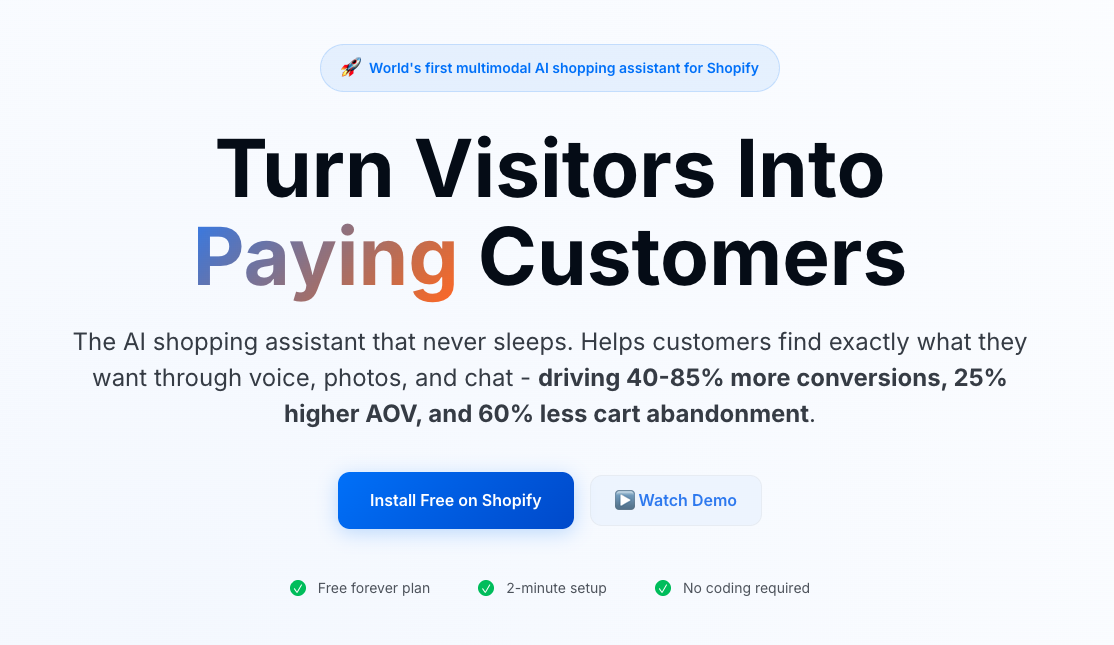
The central friction in most Shopify stores originates from a structural mismatch: shoppers conceptualize products in terms of images, aesthetics, moods, and use cases. Your inventory is organized by categories, collections, and SKU identifiers. These two organizational systems share almost no common vocabulary.
A customer glimpses a product photo on Instagram and arrives at your store wanting "something with that vibe." Your navigation system forces them to:
- Browse categories (5+ clicks to narrow down)
- Apply filter dimensions (3–4 additional interactions)
- Compare individual products (2–3 clicks per comparison)
By their fifteenth click, 60% abandon without adding anything to a cart. Not because your products are wrong. Because translating customer intent into your store's organizational taxonomy requires cognitive labor that customers are unwilling to perform.
Zenor AI bridges this gap by letting customers express what they want through natural modalities — describing it aloud, showing a photo, or having a conversation — and mapping that intent back to your actual inventory. The result: customers locate suitable products in 30 seconds that would have required three minutes of category navigation.
When Product Discovery Becomes the Conversion Bottleneck
E-commerce businesses invest significantly in inventory management, logistics infrastructure, and marketing acquisition. They chronically underinvest in the moment that matters most: when a motivated buyer is actively trying to locate what they want to purchase.
The problem traces to a fundamental assumption in how stores are organized. Traditional category-based navigation presumes customers think the way your inventory system is structured. They don't. Shoppers think in aesthetics, moods, constraints, and imagined use cases. Your store taxonomy reflects warehouse organization logic. When these two frames collide, the result is search abandonment — customers leaving not because your store lacks the right product, but because finding it demands translation work that should be the store's job, not the customer's.
Zenor AI functions as that translation layer: accepting customer input in whatever form they naturally provide — spoken description, visual inspiration, conversational query — and resolving it to specific products in your catalog.
Three Interaction Modes, One Unified Interface
Voice Shopping: The Underrated Modality
Customer says: "I need a minimalist desk lamp that doesn't take up much space."
The AI parses the intent:
- Product category constraint (lamps)
- Aesthetic descriptor (minimalist → simple geometry, limited color palette)
- Spatial constraint (compact footprint → appropriate for desk use)
- Returns products matching all three dimensions, not random lamps from the lighting category
The voice model achieves this because it's trained against your specific catalog attributes, not generic product taxonomies. It understands what "minimalist" means in the context of your inventory.
Photo Search: Mapping Inspiration to Inventory
Customer uploads an inspiration image from Pinterest, Instagram, or a competitor's website. The AI extracts:
- Visual characteristics (color palette, material indicators, silhouette)
- Stylistic classification (industrial, minimalist, bohemian, mid-century, etc.)
- Form-factor identification (what shape and type of product is being shown)
- Quality-tier signals (premium versus budget aesthetic indicators)
The platform returns products that match the aesthetic intent of the inspiration image, not a pixel-level visual match. A customer uploads a competitor's mid-century sofa. Zenor finds your store's mid-century-design sofas — different specific products, same aesthetic category. The customer buys because the style matches, even though the specific product differs from their inspiration.
Conversational Shopping: The Natural Discovery Path
Customer types: "I work from home and my apartment has almost no storage space. I need a desk that can also work as a dining surface."
The AI processes:
- Space constraint (compact footprint required)
- Dual-function requirement (desk + dining capability)
- Context signal (home office environment)
- Returns space-efficient desks with dining functionality
The conversation continues: "Ideally under $500?"
The AI refines within the newly specified price range while maintaining all previously established constraints. This conversational narrowing mirrors how people actually shop — with friends, discussing trade-offs, iterating toward a solution.
Revenue Impact: What the Numbers Show
Stores deploying Zenor AI report across multiple implementations:
Conversion metrics:
- +32% conversion rate within multimodal search interactions
- +23% increase in average order value
- −41% reduction in cart abandonment
Traffic efficiency:
- 58% reduction in search-to-abandonment rate
- 18% of total orders originating from voice or photo interactions
- +4.2x product discovery rate per average session
Customer experience indicators:
- −39% support inquiry volume (AI resolved questions directly)
- +26% repeat visit frequency
- +31% customer satisfaction score improvement
Deployment velocity: Two-minute installation from the Shopify App Store. Twenty-four hours to complete catalog ingestion and model training. Results visible within the first 50 customer interactions.
Three Merchant Implementations
Fashion Boutique (2,400 SKUs): Starting state: 68% mobile bounce rate, 1:32 average session duration, 1.1% mobile conversion rate. Customer frustration: "Can't find anything, too many options to browse through." Approach: Photo search implemented as primary discovery mode, voice as secondary complement. After 12 weeks: 38% mobile bounce rate, 3:47 average session duration, 3.2% mobile conversion rate. Forty-seven percent of customers actively using photo or voice search modalities. Revenue impact: approximately $12K additional monthly sales from existing traffic volumes.
Home Goods Store (1,200 SKUs): Starting state: Category navigation breaking down at scale. 54% search abandonment. $180 average order value. Approach: Voice and photo search optimized for aesthetic-driven intent recognition. After 8 weeks: 22% search abandonment. $234 average order value. Thirty-four percent of orders now include products from two categories that were previously considered siloed. Revenue impact: approximately $8K monthly from improved cross-category discovery.
Electronics Retailer (800 SKUs): Starting state: Specification-heavy search overwhelmed customers. "Laptop under $1,500 for coding" returned irrelevant results. 73% cart abandonment rate. Approach: Conversational mode enabled for intent-rich, natural-language discovery. After 10 weeks: 51% cart abandonment. 4:20 average session duration. Twelve percent of sales originating from voice or chat interactions. Revenue impact: approximately $6K monthly from reduced abandonment.
Pricing Structure
Free Tier (50 interactions monthly): Full multimodal access — voice, photo, and chat search. Basic customization options. Community support. Designed for evaluation and very-low-volume stores.
Starter ($20 monthly, 500 interactions): Designed for stores with 10–100 daily visitors. Email support. Custom branding color configuration. Typical ROI: approximately 15x by month three.
Growth ($60 monthly, 5,000 interactions): Professional tier for stores with 100–1,000 daily visitors. Priority support. Detailed interaction analytics — which modality drives the most conversions? A/B testing for optimization. Typical annual ROI: 20–30x.
Enterprise ($200+ monthly, 10,000+ interactions): High-volume merchant tier. Dedicated onboarding support. Custom model training. API access. Designated account manager.
All tiers include continuous model updates. New features deploy automatically.
Competitive Positioning
| Dimension | Zenor AI | Traditional Chatbot | Standalone Visual Search | Basic Search Filter |
|---|---|---|---|---|
| Voice understanding | Advanced commerce NLP | Generic keyword match | N/A | N/A |
| Photo recognition | Multi-attribute analysis | N/A | Single-image reverse | N/A |
| Chat capability | Contextual, conversational | Scripted, rigid | N/A | N/A |
| Learning rate | Improves per-store continuously | Static | Static | Static |
| Mobile optimized | Yes | Often desktop-first | Moderate | Moderate |
| Conversion focus | Explicit (AOV tracking) | Generic | Implicit | None |
| Setup friction | Minimal (3 minutes) | Minimal | Minimal | None |
Zenor's structural advantage: a unified multimodal interface means customers naturally gravitate toward whichever input mode fits their current need and context, without switching between separate tools to use different search modalities.
Deployment Workflow
Installation (approximately 3 minutes): Install from the Shopify App Store, authenticate via OAuth, and the assistant widget appears on your storefront automatically.
Configuration (approximately 5 minutes): Customize widget color and on-screen position, set the initial greeting message, and enable or disable individual interaction modes.
Training (automatic, approximately 24 hours): The platform catalogs your product inventory, builds an attribute database, and trains the AI on your product descriptions and category structure.
Optimization (ongoing): Monitor which modality drives the highest conversion rate, A/B test conversation-starter prompts, and refine based on observed customer interaction patterns.
No developer resources required. No API key management. No custom code deployment.
Who Benefits Most
Fashion and apparel: Visual discovery aligns with how customers actually think about clothing and style purchases.
Home and décor: Aesthetic intent is the primary purchase driver. Photo inspiration directly maps to inventory.
Specialty retailers with 500+ SKUs: When inventory depth exceeds what traditional navigation categories can effectively organize.
Mobile-dominant audiences: Voice and photo input dramatically reduce friction compared to typing search terms on a phone keyboard.
Catalog-heavy operations: When the volume of products exceeds what any navigation taxonomy can make discoverable.
Brands targeting Gen Z demographics: For whom conversational AI interaction is an expected baseline, not a novelty feature.
High cart-abandonment stores: Where discovery friction is the identified primary source of checkout leakage.
What Delivers Exceptionally
- Installation simplicity: Genuinely 3 minutes from app store to live on your storefront
- Unified modality architecture: Single interface supports voice, photo, and chat without separate tool configuration
- Commerce-specific AI training: Understands shopping intent, not just general-purpose language
- Mobile-native design: Touch, voice, and camera input all optimized for mobile interaction
- Native Shopify integration: Feels like part of the platform rather than a bolted-on third-party widget
- Revenue-attributable analytics: Specifically tracks which interactions drive measurable sales
Acknowledged Limitations
- Catalog-quality dependency: The AI learns from your product data. Sparse or incomplete product descriptions produce correspondingly weaker recommendations
- Category-tag assumption: Performance improves when products carry proper category classifications
- Large-catalog training lag: Stores with 1,000+ SKUs have longer initial model-training cycles
- Shopify-exclusive: Currently available only for Shopify — no WooCommerce, Magento, or custom platform support
- International language breadth: Language support is strongest for major languages; less widely spoken languages receive less robust coverage
Financial Justification
For a store generating $50K monthly revenue with industry-standard 70% abandonment rates:
- Potential abandoned-cart recovery value: approximately $17.5K
- Conservative Zenor recovery estimate (30% of abandonments): roughly $5.2K incremental monthly
- Platform cost: $60 monthly (Growth tier)
- Annual ROI: approximately 87x ($5,100 net monthly benefit)
For a store generating $10K monthly:
- Recovered abandonment value: roughly $300–500 monthly incremental
- Platform cost: $20 monthly (Starter tier, often the free tier is sufficient)
- Annual ROI: approximately 15–25x
Even conservative impact assumptions produce breakeven within days of deployment.
Final Verdict
Zenor AI succeeds because it correctly identifies the root cause of e-commerce conversion friction: product availability isn't the problem — product findability is. Customers don't abandon because your inventory is inadequate. They abandon because navigating to the right product within your store's taxonomy requires translation effort that most visitors won't invest.
By enabling customers to express purchase intent through the modalities they naturally use — describing verbally, showing visually, conversing naturally — the platform converts discovery friction into conversion velocity. The multimodal architecture isn't a novelty feature. It's recognition that different shoppers prefer different communication channels, and the store that supports all three captures more of every visitor's purchase intent.
Rating: 4.6/5 stars
Delivers: Genuinely rapid deployment. Functions across voice, photo, and conversation modes simultaneously. Reliably improves conversion metrics. Pricing structure aligns with delivered value.
Growth areas: Requires well-structured product data to perform at its best. Shopify-exclusive limits addressable market. Catalog training for very large stores involves a waiting period.
Ready to let your customers find products the way they naturally think about them?
👉 Start Free Trial and experience multimodal search in action on your Shopify store.
Tags
# Review# Zenor AI# AI shopping assistant# Shopify AI assistant# Multimodal shopping AI# Voice shopping assistant# Photo-based product search# AI for e-commerce stores# Review# Personalized product recommendations# AI product search for Shopify# Boost Shopify conversion rates# Increase average order value Shopify# 24/7 virtual sales assistant# No-code AI integration Shopify# AI-powered upsell for Shopify stores# Shop by photo Shopify# Free AI Shopify app# Shopify multimodal assistant# Conversion rate optimization# Enhanced customer experience# AI-driven personalization# Visual search technology# Voice commerce# Intelligent product recommendations# E-commerce AI solutions# Shopify store optimizationShipping Cost Calculator Review - Compare USPS, UPS, FedEx & DHL Rates and Save Up to 70%
QuizShot Review - AI Chrome Extension Solving Homework Problems in Seconds with 95% Accuracy
Follow for new blogs
Subscribe to our blog
Subscribe to Newsletter
Subscribe to our newsletter to get the best products weekly.