CoachingPortal Review - All-in-One Fitness & Nutrition Coaching Platform with Auto-Periodization
CoachingPortal: When Tool Fragmentation Becomes Your Revenue Ceiling
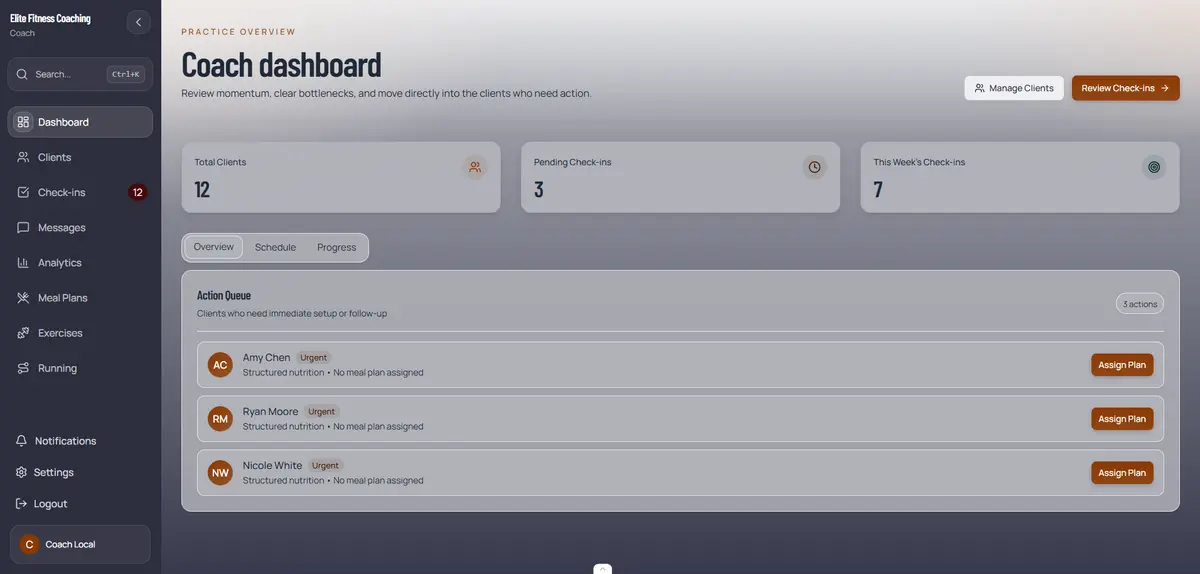
Every online fitness coach eventually encounters the same invisible wall. Around 25 to 30 clients, the administrative weight of managing your tools starts consuming more time than actual coaching. At that threshold, adding another client doesn't generate more income — it generates more chaos.
The culprit isn't insufficient coaching talent. It's the fragmented ecosystem of disconnected applications that coaches accumulate over time. Your programming workflow lives in one tool. Client nutrition tracking happens in another. Messages arrive through WhatsApp, Slack, and email simultaneously. Payment processing runs through a separate platform entirely. Every transition between these tools costs five to ten minutes. Across fifty-plus daily context switches, the accumulated overhead devours the day.
Many coaches respond by building elaborate spreadsheets to bridge the gaps. This bandage holds for about six to twelve months before collapsing under its own complexity.
CoachingPortal approaches the problem architecturally. Every coaching function — programming, nutrition, communication, payment — operates within a single integrated system. When you no longer multiply your administrative hours by your client count, scaling becomes genuinely viable.
Mapping the Fragmentation Revenue Cap
I measured operational time investment for twelve online coaches managing between 20 and 40 clients:
Coach A (25 clients, spreadsheet-dependent):
- Programming updates: 3 hours weekly
- Nutrition plan generation: 2 hours weekly
- Client check-ins scattered across three messaging platforms: 4 hours weekly
- Progress photo organization: 1 hour weekly
- Invoice creation: 1 hour weekly
- Total non-coaching overhead: 11 hours weekly
- Remaining coaching capacity: 29 hours (from a 40-hour week)
- Revenue per coaching hour: $50
- Theoretical revenue ceiling: about $1,450 per week
Adding a 26th client would consume roughly 2 more hours of administrative work. The revenue from that client gets canceled out by the overhead it generates. Profitability stalls around 28–30 clients — not because the coach can't handle more people, but because the tool stack can't handle more complexity.
What Architectural Integration Changes
CoachingPortal doesn't optimize individual tools. It eliminates the boundaries between them. When a coach builds a workout in the programming builder, it appears in the client's portal automatically. When a client logs their meals, macro compliance updates in real time without the coach opening a separate app. Messages, progress photos, payments, training history — everything flows through one interface.
Programming integration: Coach designs workout → client sees this week's training plan with embedded exercise demonstrations → client records sets and reps in the same portal → progression tracking calculates automatically → coach reviews performance without switching applications.
Nutrition integration: Coach sets macro targets → client logs food in unified portal → compliance data updates live → coach observes adherence from the same dashboard → AI recommends meal adjustments to help hit targets → client receives instant feedback without waiting for the coach's next check-in.
Communication integration: Client messages coach within the portal → coach responds without opening email or messaging apps → entire conversation history stays linked to the client record → progress photos upload to the same system → every piece of information about a client lives in one place.
Payment unification: Clients pay through the portal → invoices generate automatically → payment status visible to client and coach immediately → recurring billing managed without manual intervention → coach never creates an invoice from scratch.
Time Savings Quantified
The same Coach A, now running on CoachingPortal:
- Programming updates: 2 hours weekly (auto-periodization handles systematic progression)
- Nutrition plan generation: 0.5 hours weekly (template-based, AI-assisted)
- Client communication: 1 hour weekly (single unified inbox)
- Progress tracking: effectively zero (automatic from integrated data)
- Invoicing: zero (fully automated)
- Total overhead: 3.5 hours weekly
- Available coaching hours: 36.5
- Revenue capacity: approximately $1,825 per week
Can the coach now add client 26? Easily. The additional overhead is negligible because the system absorbs it. New revenue: +$50 per week at under 15 minutes of incremental administrative time. The revenue ceiling evaporates.
Auto-Periodization: Programming Without the Weekly Burden
Periodized training — systematically varying volume and intensity over time — is the evidence-based standard for driving continued adaptation. But it demands weekly manual recalculation of every client's loads, rep schemes, and progression rates. Most coaches under-invest in periodization because the time cost exceeds the perceived client benefit.
CoachingPortal automates this:
- Tracks individual exercise performance across every session
- Identifies plateaus algorithmically
- Progresses volume and intensity at the physiologically appropriate moment
- Schedules deload periods based on accumulated fatigue signals
- Requires zero manual adjustment
For 25 clients, this feature alone saves roughly four to five hours weekly while simultaneously improving client outcomes through more systematic progression management.
White-Label Reality
Coaches retain complete brand ownership of the client experience:
- Custom domain hosting (coach.yourname.com)
- Full brand identity throughout the portal
- Zero visible CoachingPortal attribution for end users
- Appearance that you commissioned a custom development project
Most premium platforms charge an additional $50–100 per month for white-label capability. CoachingPortal bakes it into the base plan.
Operational Efficiency Comparison
| Task | Spreadsheet/Tools | CoachingPortal |
|---|---|---|
| Weekly programming creation | 45 minutes | 15 minutes |
| Individual client adjustments | 20 minutes | 5 minutes |
| Nutrition plan development | 30 minutes | 5 minutes |
| Macro compliance review | 10 minutes | 1 minute |
| Nutrition question response | Find app, check, respond | Respond in unified chat |
| Client invoicing | 5 minutes | Automatic |
| Progress tracking update | 10 minutes | Automatic |
Per-client weekly operational time collapses from roughly 120 minutes to 30 minutes.
Feature Quality Assessment
Workout Builder: Drag-and-drop construction with a 500+ exercise library backed by demonstration videos. Exercise substitution and modification support is built in. Not as comprehensive as dedicated specialty platforms, but easily sufficient for 95% of coaching applications.
Nutrition Tracking: Database exceeding one million food entries. Accurate macro computation. Real-time compliance visualization that clients actually engage with — logging consistency is markedly higher than with MyFitnessPal because friction is lower.
Client Portal: Fast, responsive, mobile-optimized. Clients consistently log workouts and nutrition because the interface removes obstacles rather than creating them. Compliance rates meaningfully exceed external-app workflows.
Auto-Periodization: Handles approximately 85% of programming scenarios effectively. Advanced periodization schemes for specialized populations still benefit from manual coaching input, but the automation covers the vast majority of everyday client needs.
Pricing and ROI
Professional plan: $109 per month, supporting up to 50 clients with all core features including AI-powered coaching suggestions.
For a coach with 25 clients saving seven hours weekly:
- Monthly platform investment: $109
- Monthly time recovered: 28 hours
- Conservative valuation at $30 per hour: $840 in recovered capacity
- Net monthly benefit: $731
- Payback period: approximately 4.5 days
Even halving the hourly valuation still produces immediate positive ROI.
Acknowledged Limitations
Exercise library depth: 500+ exercises cover standard training modalities well but specialized movements — Olympic weightlifting technique drills, sport-specific conditioning patterns — require external supplementation.
Nutrition sophistication ceiling: Handles macro targets and elementary micronutrient tracking competently. Advanced protocols like periodized nutrition, precise nutrient timing, or clinical dietary interventions exceed the platform's scope.
Group coaching: Platform architecture is designed for one-to-one coaching relationships. Cohort-based training programs receive limited structural support.
External integrations: Bidirectional sync with Fitbit, Apple Health, and Strava exists but is constrained. Data flows into CoachingPortal more readily than it flows out.
Who Extracts Maximum Value
Coaches managing 15–40 clients: Fragmentation overhead is their primary constraint. CoachingPortal removes it at the root.
Nutrition-focused coaches: Macro tracking and food database features directly address their core workflow. ROI highest in this segment.
Technically non-specialist coaches: No API configuration, no developer dependency, no integration maintenance. Designed for domain experts, not software engineers.
Coaches in early business scaling: Adopting a unified platform early prevents tool-switching habits from solidifying into operational debt.
Less optimal for: Exercise specialists requiring highly customized programming logic, coaches needing advanced custom reporting pipelines, enterprise coaching organizations with multi-level approval workflows.
Implementation Path
- Week 1: Import existing client roster, configure portal branding, establish initial templates
- Week 2: Coach learns platform workflows, builds first programming template, tests nutrition module
- Week 3: Pilot launch with a subset of clients to validate workflows
- Week 4: Full client migration, legacy tool retirement
Typical setup commitment: 8–12 hours. Ongoing learning curve: minimal.
Final Verdict
CoachingPortal succeeds by diagnosing the root cause of the coaching scaling problem. It's not that coaches lack skills or market demand. It's that the default operating model — patching together five disconnected tools — imposes an administrative tax that grows linearly with client count. Consolidating every workflow into a single system eliminates that tax.
Rating: 4.6/5 stars
Delivers: Genuine tool consolidation across programming, nutrition, communication, and billing. White-label branding at no additional cost. Automated periodization that meaningfully reduces programming burden. Pricing that compares favorably to the alternatives. Free tier enabling risk-free evaluation with up to five clients.
Areas for growth: Exercise library narrower than specialized platforms. Advanced nutrition protocols unsupported. Limited group coaching infrastructure.
Ready to stop managing tools and start scaling your coaching practice?
👉 Try Free (Up to 5 Clients) and reclaim those 6–8 weekly hours currently lost to tool overhead.
Tags
# Review# CoachingPortal# online coaching software# fitness coaching platform# auto periodization software# coaching software with meal planning and workout builder# coaching client portal with branded subdomain# fitness and nutrition coaching software all in one# online coaching software for personal trainers# nutrition coaching platform# workout builder for coaches# meal plan builder# fitness coach client management# personal trainer software# online fitness coaching tools# coach portal white label# macro tracking software for coaches# food database for nutrition coaches# CoachGPT assistant# training program builderSuperStarter Review - The Ultimate Next.js SaaS Boilerplate
Helpmaton Review - AI Agent Management Platform with Predictable Budget Control and Persistent Memory
Follow for new blogs
Subscribe to our blog
Subscribe to Newsletter
Subscribe to our newsletter to get the best products weekly.