Cashwerk Review - All-in-One Workflow Platform for Business Efficiency
Cashwerk: Designing Operational Systems That Scale With You
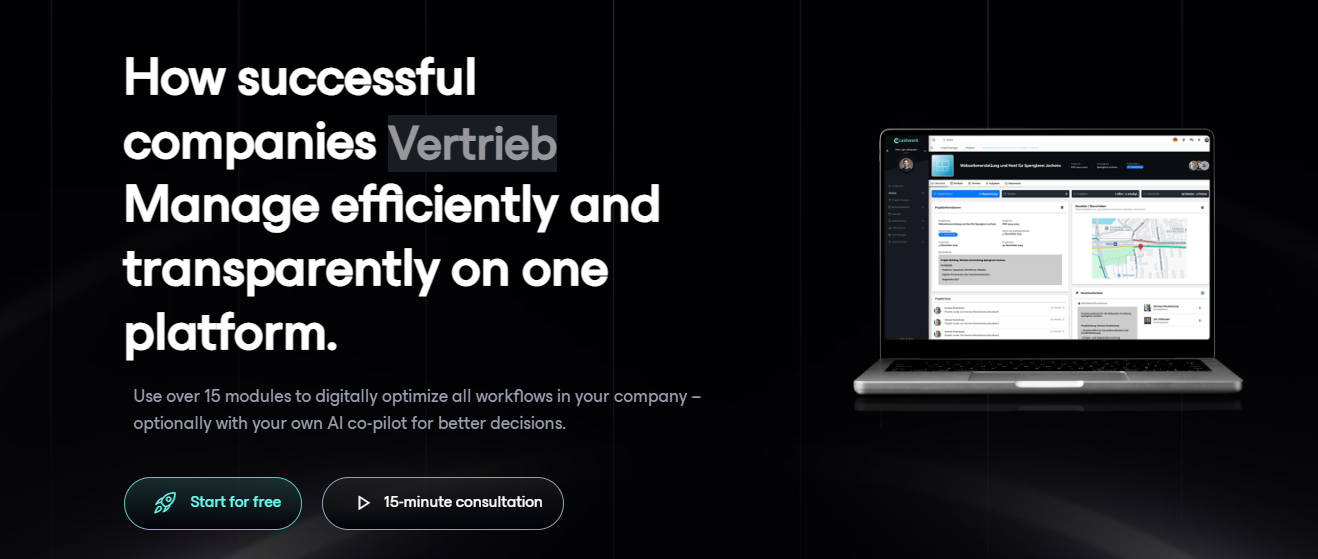
Business growth follows a deceptively predictable trajectory when it comes to tooling. At micro-scale, manual coordination across a handful of people works fine — spreadsheets hold customer lists, email serves as the primary coordination mechanism, and everyone maintains their own mental model of what's happening. Success triggers hiring, which forces process documentation, which becomes impossible when the systems underpinning those processes don't talk to each other.
At five people, the spreadsheet approach holds. At fifteen, it becomes actively dangerous — conflicting versions of the same data proliferate, nobody has a complete picture, and revenue leaks through gaps nobody can see. At fifty, manually moving data between disconnected systems becomes someone's full-time job.
Cashwerk's architectural thesis is straightforward: businesses that survive this scaling gauntlet do so because their operational infrastructure was designed for cross-functional integration from day one, not retrofitted after the sprawl had already calcified.
The Fragmentation Problem at Scale
I studied how growing German SMBs manage operational data across different company sizes:
The 5–15 person stage: Tooling barely communicates. Customer information lives in whichever CRM the sales team prefers — but finance tracks invoices in a separate system, projects are managed in Notion or spreadsheets, and the primary cross-functional coordination tool is still email. Revenue leaks through unbilled work, compliance gaps emerge from missing documentation, and strategic decisions get made against outdated financial snapshots.
The 15–50 person stage: Someone gets hired specifically to manage the data flows between systems. This person spends 40+ hours weekly on manual data reconciliation — entering information from one system into another, chasing down inconsistencies, producing reports that are stale by the time they're finished. Approximately 15% of revenue genuinely disappears through billing oversights and forgotten chargeable services.
The 50+ person threshold: Most companies at this scale have already been forced to rebuild their operational systems entirely at least once, at significant cost and organizational disruption.
Cashwerk targets the 15–50 person stage — the window where growth creates acute operational pain but budgets haven't yet expanded to accommodate enterprise-grade ERP implementation.
Revenue Flow as the Central Organizing Principle
Conventional business software treats revenue as a downstream output — something you calculate after sales, delivery, and billing have all happened in isolation. Cashwerk inverts this model: the revenue flow becomes the central nervous system that every other module connects to.
This architectural choice produces cascading integration benefits:
Customer data flows into the sales pipeline natively: Not replicated across systems through manual exports, but sourced from the same structured record that finance and project management reference.
Sales activity generates financial artifacts automatically: Accepted quotes become invoice templates. Approved proposals become project structures. There's no manual handoff where information degrades between departments.
Project execution feeds the billing engine continuously: Hours logged against a project automatically flow into the invoicing system as billable line items. No end-of-month scramble to reconstruct what work was done for whom.
Support visibility illuminates upstream processes: Customer issues flagged in the support queue surface as potential improvements to sales qualification, project scoping, and product development. The support module feeds signals back to the modules that can prevent future issues.
This isn't superficial integration — it's architectural interlock. The modules don't need adapter layers because revenue flow is the native language that every module speaks.
A Realistic 90-Day Implementation Timeline
Unlike enterprise ERP deployments that consume quarters of organizational attention:
Month 1: Historical data migration — customer records, active projects, outstanding invoices. Team training on the core workflows begins. Legacy systems operate in parallel during the transition.
Month 2: Departmental cutover in sequence — sales moves first (customer management and pipeline visibility produce immediate benefits), followed by project delivery (time tracking and resource allocation), then finance (invoicing and accounting consolidation).
Month 3: Full operational migration with systematic optimization. Teams discover patterns in their own data that were invisible under the fragmented old model. Processes improve based on visibility that didn't previously exist.
No big-bang switchover. No system outage window. Progressive adoption with immediate value accrual at each phase.
The Integrated Feature Stack
CRM Module: Positioned as a relationship operations center rather than a contact database. Every customer interaction is logged and retrievable. Pipeline visibility surfaces not just deal status but deal blockage — information automatically synthesized from support tickets, project history, and communication records.
Project Management Module: Tracks time, deliverables, and team collaboration. Hours automatically cost against project budgets. Profitability becomes continuously visible rather than a monthly retrospective accounting exercise.
Financial Operations Module: End-to-end quote-to-invoice automation. Overdue invoice management handles dunning automatically. Multi-currency and multi-tax complexity is handled by the system rather than by staff. Real-time profit and loss visibility extends beyond the accounting team.
Support Module: Ticketing with intelligent routing logic. High-value customer issues escalate immediately. Recurring problems surface as systemic signals rather than isolated tickets.
AI Copilot (Casper): Context-aware process automation that understands your complete business landscape and proactively surfaces opportunities: "Project X is complete — generate the final invoice," "Client Z's contract renewal window opens in 14 days — schedule a conversation," "This support issue matches three previous reports of the same underlying problem — here's the resolution pattern."
The Economic Case: Fragmentation Tax vs. Consolidation
For a representative German SMB with 25 employees:
Current fragmented-system costs:
- One full-time-equivalent employee managing data flows between systems: €4,000 monthly
- Two to three employees spending portions of their week copying data between systems: €500 monthly in lost efficiency
- Revenue leakage from unrecorded billable hours: €2,000–3,000 monthly
- Compliance exposure: unquantified but materially real
- Total hidden fragmentation cost: €6,500–7,500 monthly
Cashwerk implementation cost:
- Software licensing: €69 per month
- One-time migration effort: approximately €2,000
- One-time training investment: approximately €800
- Ongoing savings: the data-entry FTE redeployed to revenue-generating work
Payback period: One to two weeks from go-live.
Positioning in the German Market
versus Salesforce: Salesforce dominates on ecosystem extensibility but costs approximately 10x more. For SMBs, Cashwerk's price-to-capability ratio is dramatically more favorable.
versus SAP: SAP wins on enterprise-scale feature depth and global deployment capability. Cashwerk wins on implementation velocity and accessible pricing for organizations that don't need planetary-scale ERP.
versus Home-Grown Integration Platforms: Custom-built workflows stitched together with Zapier or Make are initially cheaper but accrue maintenance debt that breaks during growth spurts. Cashwerk trades early-stage flexibility for long-term architectural coherence.
Unique Cashwerk Differentiator: Purpose-built for the German regulatory environment. GDPR and GoBD compliance are architectural properties baked into the platform's design, not compliance checklists to be configured post-deployment.
Acknowledged Limitations
Learning curve: The platform necessarily carries the complexity required to support genuine cross-functional integration. Teams accustomed to single-purpose point solutions will need an adjustment period.
Customization depth: The core platform is opinionated about operational best practices. Departing significantly from these defaults requires professional services engagement.
Scalability ceiling: Excellent fit for organizations up to 200–300 employees. Beyond that threshold, enterprise-grade solutions with dedicated federation capabilities may provide better infrastructure.
Integration ecosystem breadth: Fewer pre-built third-party connectors than mature enterprise platforms. Unusual integration requirements may demand custom development work.
Who Extracts Maximum Value
Service agencies managing multiple client relationships: All clients, projects, and billing flows unified in a single operational system. Per-client profitability becomes continuously visible.
Professional services firms: Billable time tracking, project profitability analysis, and client relationship management converge. The financial team operates with real-time visibility into firm performance rather than monthly reconciliations.
Freelancers transitioning to team scale: Start on the freelancer plan. Grow into team infrastructure without replacing the operational backbone.
Subscription-based businesses: Recurring billing, customer lifecycle management, and churn analysis infrastructure built in from the start rather than bolted on later.
Manufacturing SMBs: Order-to-production-to-accounting flows automate cleanly. Finance maintains a real-time understanding of business state.
Compliance-sensitive European organizations: Data residency handled correctly. Tax complexity managed systematically. Document retention automated and auditable.
Final Verdict
Cashwerk succeeds by understanding that businesses in growth phases need infrastructure designed for integration from inception — not assembled from disconnected tools after organizational complexity has already set in. It's not a fit for organizations that prioritize maximum customizability or bleeding-edge feature expansion. For European SMBs exhausted by manual data wrangling and growth-constrained by operational fragmentation, it's the most rational consolidation option available.
Rating: 4.7/5 stars
Delivers: Genuine cross-functional business integration. Rapid implementation trajectory. SMB-appropriate pricing. Architecturally sound European compliance. AI-powered process optimization suggestions.
Growth areas: Learning curve steeper than single-purpose alternatives. Deep customization requires professional services investment.
Ready to align your operational systems with your growth trajectory?
👉 Try Free and experience what unified operations feel like.
Tags
# Review# Cashwerk# workflow# Enterprise Resource Planning# Customer Relationship Management# Deal-pipeline# Support-Pipeline# Taskmanager# timetracking# project management# Document Management System# workflow Software# platform# all-in-one business platform# ERP solution# CRM software# AI copilot# business automation# GoBD compliant# DSGVO compliant# German hosted platform# small business ERP# mid-sized company software# agency management tool# freelancer business solution# invoice management# project tracking# time tracking software# customer support ticketing# cashflow managementAxo Analytics Review - Privacy Focused Website Analytics Without Cookies
Query Streams Review - The Ultimate Power Query Alternative for Real-Time SQL Data in Google Sheets & Excel
Follow for new blogs
Subscribe to our blog
Subscribe to Newsletter
Subscribe to our newsletter to get the best products weekly.